Improve Your Google Analytics Social Media Marketing
Restored from the Empower Network archive (2011–2017), lightly edited to meet our current advertising standards. Views are the original author’s.
Have you ever thought to use Google Analytics Social to Check On where People are finding you on Social Media?
Want to know which of your links are attracting more traffic?
When you see referral traffic from Facebook it is great, but wouldn’t it be nice to know which wall post attracted it?
Which makes visitors stay longer on your website? Those from Twitter or from a banner ad?
This article shows you how to take your google analytics social strategy to the next level. (with thanks to Brian Reilly and Social Media Examiner )
About Google Analytics Social Custom Campaigns
You can assign a custom campaign tag to the links you share on social networking sites. This enables you to fully use Google Analytics to gain valuable insights into how well your various social networking site presences are working for you.
Google Analytics makes custom campaigns incredibly easy to work with. By using their Custom URL Builder, you can create specific links for each of your campaigns and use these to share online.
Google Analytics can then give you much more information based on how people use your custom links. And you can use this information to gain a better understanding of your referral traffic and adjust your social media marketing for optimum results.
There are several ways you can categorise your links before setting up your first campaign.
Google Analytics Social Custom Campaign Parameters
Here are five parameters that can be added to a URL:
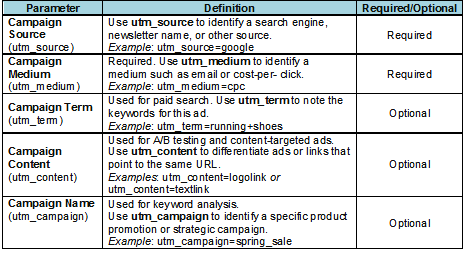 You need to set parameters for your custom campaign.
Before providing step-by-step instructions below for assigning Google Analytics Social Custom Campaign Parameters to create the URL link you’ll want to use, here’s a look at how one company harnessed the power of custom campaigns.
NUK-USA Measures the Effectiveness of Social Marketing With Google Analytics Social Custom Campaigns
NUK-USA, a popular brand of pacifiers and sippy-cups in North America, is leveraging the power of Google Analytics. NUK-USA currently amends their URLs with campaign tags to measure the effectiveness of the various media they use: Facebook, Twitter, Pinterest, email blasts, etc.
Here is a Facebook post that brought in 49 likes and 51 comments.
If you want to know
- how many users clicked through,
- how many pages were viewed,
- how much time did visitors spend on the website and
- how many new visits were produced?
then you need to tag your links correctly.
What link did they use for Google Analytics Social?
NUK-USA uses bitly, a popular free link shortening service, to shorten the links they use online.
When URLs have custom campaign parameters added, they become ugly and bulky. Many marketers take their long links and enter them into a URL shortening service to make them look more user friendly.
Once the bitly link is clicked within the wall post, the link is presented in the browser. Wow, it’s a long one!
http://www.nuk-usa.com/all-products/pacifiers.aspx?utm_source=Facebook&utm_medium=Facebook_Post&utm_campaign

=Facebook_Post_Pacifiers_9.27
Let’s look at the different parts of this link:
- utm_source: Facebook (The traffic coming from this link originates on Facebook.)
- utm_medium: Facebook_Post (The traffic originated on Facebook and was shared within a Facebook wall post.)
- utm:_campaign: Facebook_Post_Pacifiers_9.27 (If there are multiple posts implemented in one day, providing a utm_campaign value helps to roll up all post data into one campaign value.)
It’s not just about likes, comments and shares
By implementing custom tagging within Google Analytics Social, NUK-USA is able to see several data points that they wouldn’t have otherwise, unless they spent the extra time tagging the URL. Here’s what their Google Analytics showed them:
- 64 users clicked from the Facebook post onto the website. Compared to the 49 likes and 51 comments, the click-through on this post is incredibly high.
- 4.09 pages were viewed on average per visit. The content on the site is sticky and successfully brings users to other parts of the website.
- The user spends, on average, 00:01:57 on the site, navigating through the 4.09 pages.
- 75% of the users clicking through the Facebook wall post are new visitors. Bringing new visitors to a website is always a plus!
Follow These Steps to Set Up Your Own Campaign With Google Analytics Social
- Go to Google Analytics Custom URL Builder.
- In the Website URL field, enter the destination page to send users to.
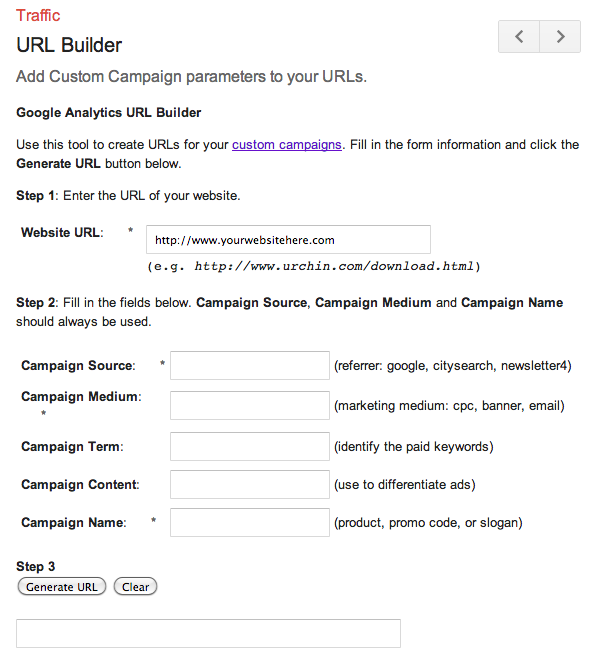 Enter the URL of the website for which you plan to generate a link.
- Fill in the Campaign Source to identify the origin of the visit (Facebook, Twitter, email blast, etc.).
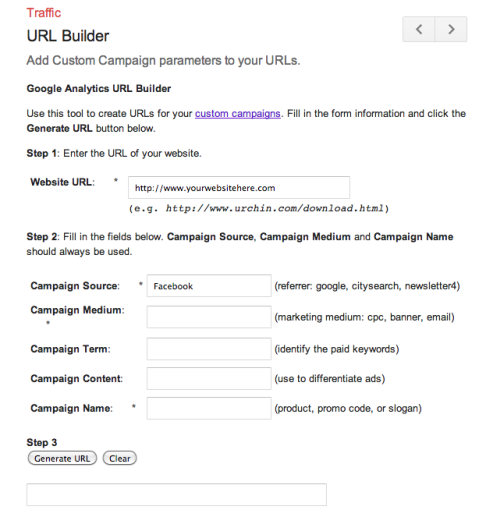 Enter the location where you plan to use the URL. Is it with a search engine? Is it on Facebook? Email marketing platform?
- Fill in the Campaign Medium to identify the vehicle for link delivery (wall post, tweet, etc.).
Fill in the location where the URL will be placed. Will it be within a wall post, tweet, paid search listing or banner ad?
- Fill in the Campaign Name to identify the campaign that the link is associated with. There can be many links rolled up under one campaign.
Enter the name of the campaign or promotion that this link supports. Is it supporting a new product launch, a holiday sale or is it intended to simply drive traffic from a source and medium? Be sure to list that out here—this field is mandatory!
- Click the Generate URL button to assemble the URL based on all of the campaign parameters specified.
All parameters are compiled into one URL. Before using this URL, be sure to log the URL into a spreadsheet so you can keep track of all URLs that have been generated. You may need to use this URL again, or you may want to reference how you decided to name your various google analytics social campaigns, sources and media. Putting in extra effort to keep your links organized will go a long way.
- Log the URL in a spreadsheet. It’s very important to keep track of the campaigns and be able to see how the various parameters are named.
Six Steps for Analyzing Campaign Effectiveness
When you are ready to see how your campaign is doing, follow these steps to see the valuable data you can now get from Google Analytics.
- Log into Google Analytics.
- Click on Traffic Sources.
- Click on Traffic Sources > Sources.
- Click on Traffic Sources > Sources > Campaigns.
Drilling down into the Campaigns report will allow you to see how well all campaigns are working for you. A campaign listing here can represent one URL or many URLs. This depends on how the URL parameters were assigned.
- Locate the campaign you wish to analyze and click on it to drill deeper.
- Review Visits, Pages/Visit, Avg. Time Spent on Site, %New vs. %Returning and Bounce Rate to make informed decisions about each social network driving people to your website.
Helpful Hints
Are you doing this for the first time? Have you done this before and want to hone your skills? You don’t have to learn the hard way! Here are some useful tips to follow.
- It’s important to keep and maintain an organized spreadsheet with all custom campaign URLs.
- If you’re tracking Facebook wall posts, it’s important to pick whether you will designate the Campaign Source as, for example, ‘Facebook’, ‘facebook’, ‘FB’ or ‘fb’, to maintain consistency.
- When assigning parameters, it’s important to use an underscore to separate multiple words in a string. Instead of inputting ‘wall post’, you’d want to enter ‘wall_post’. If a space is entered, the URL Builder will enter in ‘%2b’, which is its text translation of a space.
- When creating social media reports that summarize the value of Facebook wall posts, tweets, etc., it’s important to merge those metrics with the Google Analytics metrics (see the NUK-USA example above) for a more holistic and informed analysis of how the various social media platforms are working.
Here is a video I just made for anyone who has never used Keyword Search using the free Google Adwords Keyword Tool.
Please let me know how you go using the information on Google Analytics Social Media Tracking in this post. Once again, thanks to Brian Reilly and Social Media Examiner. Get on their email list for more fantastic Social Media hot information.
If you like this blog post on google analytics social media uses and would like to be able to easily share tips, ideas, your thoughts and favourite things online through your own blog, click , put in your best email and watch the video.
I’ll contact you after that. Good luck!
Til next time
Sue Tamani