Why PageRank Doesn’t Matter Anymore (And What You Should Focus On Instead)

Restored from the Empower Network archive (2011–2017), lightly edited to meet our current advertising standards. Views are the original author’s.
It’s amazing how many people ask me questions about Google PageRank on a regular basis.
The main concerns people tell me are –
Why doesn’t my site have higher PR – am I doing something wrong? How come such and such site has a high PR; their site sucks! How long does it take to acquire PR?
I completely understand where these bloggers are coming from. It IS nice to see that green bar show a hefty number. Good for bragging rights.
And that is DESPITE the fact that most of us know…
- Visible PageRank is only updated once in a blue moon. It used to be every three months or so; then only twice in 2010 (from what I recall) and only twice in 2011 so far.
- The PR that you in fact see for any given site might actually be higher than shown or, and this one is much worse for your link building, might’ve been lowered by Google for using spammy practices.
…I still find that most bloggers care way too much about their PageRank.
Let’s think about this for a second.
What do we really want our sites to do?
Make more money.
How do you get to your end goal?
By learning how to promote your blog to effectively draw in new readership, by providing stellar content to turn that new readership into returning visitors, email list opt-ins, business leads, etc.
Where’s your blog PageRank in all of this?
Theoretically, it only comes into play if you assume that a higher PageRank will result in higher search engine rankings, which will in turn bring in more SEO traffic, which will in turn… Well, you get the point.
However, that theory holds (almost) no water, considering that Google will rank a website with a lower PR over a site with a higher PR in a heartbeat if it finds the first site to be more relevant to the search query.
So…
If PageRank is not a good measure of your site’s true performance, then what is?
What Performance Metrics Should You Track?
We need to find a better way to determine how well our site is really doing and what we can do to make it produce better results than Google PageRank.
Fortunately, with the help of the free tools like Google Analytics or Webmaster Tools, we don’t have to go too far to find such performance-oriented metrics.
- Conversion rate
- Clickthrough rate (CTR)
- Bounce rate
1. Conversion Rate
This is a perfect metric that directly affects your end business goals.
“Conversion” happens when a website visitor performs an action you’d like for them to take, like signing up for your email list, downloading your free report, clicking on your affiliate link, etc.
The better your traffic converts, the quicker you get to your bottom line.
As a matter of fact, allow me to be as bold as to state that –
Your traffic conversion is just as important (if not more important) than your traffic generation.
After all, what’s the point of spending your time and possibly money to bring more traffic to your site, if your traffic conversion is not set up properly and your visitors simply end up leaving your site?
The simplest way to track your traffic conversion is by setting up goals in your Google Analytics account and tracking them against all your traffic.
Here’s what a typical dashboard looks like:
Now if I click on a drop-down menu located in the top-right corner under “Advanced Segments” and choose “Visits with Conversions” along with “All Visits” like this:
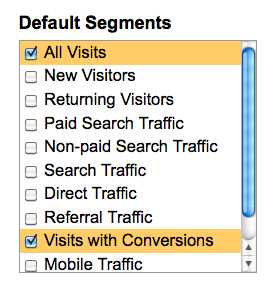
… this is what I’ll see in the dashboard:

As you can see, even though the site gets lots of traffic, that traffic doesn’t convert all too well with that particular goal in mind.
Here are full instructions on how to set up goals in Google Analytics.
2. Clickthrough Rate
Just showing up in Google search results, even on the first page for a good keyword, never means that you’ll generate much traffic from it.
You still need to make sure that the search engine users actually CLICK ON your listing and come to your site. That’s what clickthrough rate (CTR) is all about.
Just like with traffic conversion, there’s no point in working hard on your SEO, if in the end you can’t get anyone to click through to your site.
The best way to improve your CTR is to examine your titles and descriptions (also called “snippets”) that show up in the search engine results.
Are they compelling? How do they measure up against your competitors listed around you? How relevant are they to the search?
To learn how to write better snippets, check out this post from the Google snippets team (yes, they have a whole team for that!).
To see if your site could use help in the title/snippet department, take a look at the Webmaster Tools HTML suggestions section. To find it in your Webmaster Tools, in the left-hand sidebar, go under Diagnostics ==> HTML Suggestions.
I can’t stress this enough: it doesn’t matter how well your site ranks for any number of keywords, if no one clicks on it.
3. Bounce Rate
Essentially, your bounce rate tracks the number of visitors who came to your site and then left in a hurry.
Not a good thing.
It’s measured in two different ways:
- The number of visitors who came to your site and never clicked over to a different page within your site.
- The amount of time a visitor spends on your site – usually anything under five seconds counts towards your bounce rate.
Your bounce rate is a good indicator of the QUALITY of traffic you are getting to your site and how targeted that traffic is.
High bounce rate translates into lower conversions; low bounce rate, alternatively, results in better conversions and getting to your business goals a lot sooner.
To learn everything you need to know about measuring, tracking, and decreasing it, check out my post on bounce rate.
Marketing Takeaway
And there you have it.
PageRank is just a number that looks pretty in your toolbar and might get you better blog sponsors.
Improving your conversion, clickthrough, and bounce rates, on the other hand, actually helps you achieve your business goals a whole lot faster.
Love it or hate it? Comment to show me that you’re alive!